Part 2 - Gigi: Google's campus campaign for AI agents
My struggle when writing about this cute AI campaign is partly musical-theater-shaped. I can't shake the mental image of an aging Maurice Chevalier singing "Thank heaven for little girls" in a super-thick French accent.

"Each time I see a little girl of five or six or seven
I can't resist the joyous urge to smile and say
Thank heaven for little girls
For little girls get bigger every day
Thank heaven for little girls
They grow up in the most delightful way"
Track 4 on Gigi (Original 1958 Motion Picture Soundtrack) [Deluxe Edition]
Yeah...no. It felt wrong to me 20 years ago when I saw it on TV on a Saturday afternoon, but I digress.
Gigi is the name students voted for in a competition Alphabet launched on campuses to promote use of Gemini models to build AI agents. They arguably initiated the cute wave in this phase of the race.
Elsewhere AI labs were cycling through talking points about AI stealing jobs, (especially entry-level graduate jobs), and percentage chances of an AI-initiated Armageddon. The cycles all roughly tracking the huge funding rounds.
This Gigi push was for back to school in August 2025, so talk of rogue agents was still brewing, the SaaSpocalypse was a few months away, and Clawdbot's creator hadn't been hit with an Anthropic copyright claim yet.
 Kate Leggett
Google were promoting DIY agents, bots, or micro services that need your credentials (or their own), to do stuff on the internet and local devices.
The people have spoken! The love for Gigi is real, so we've made it the official name and spelling for our back-to-school mascot friend. Score one for the fans. pic.twitter.com/CGGAEqvnQL
— Google Gemini (@GeminiApp) August 29, 2025
Our back to school mascot #Gigi just got the #nanobanana treatment
— Google Gemini (@GeminiApp) September 5, 2025
Your turn. Prompt in 🧵 pic.twitter.com/xgYjvD7khJ
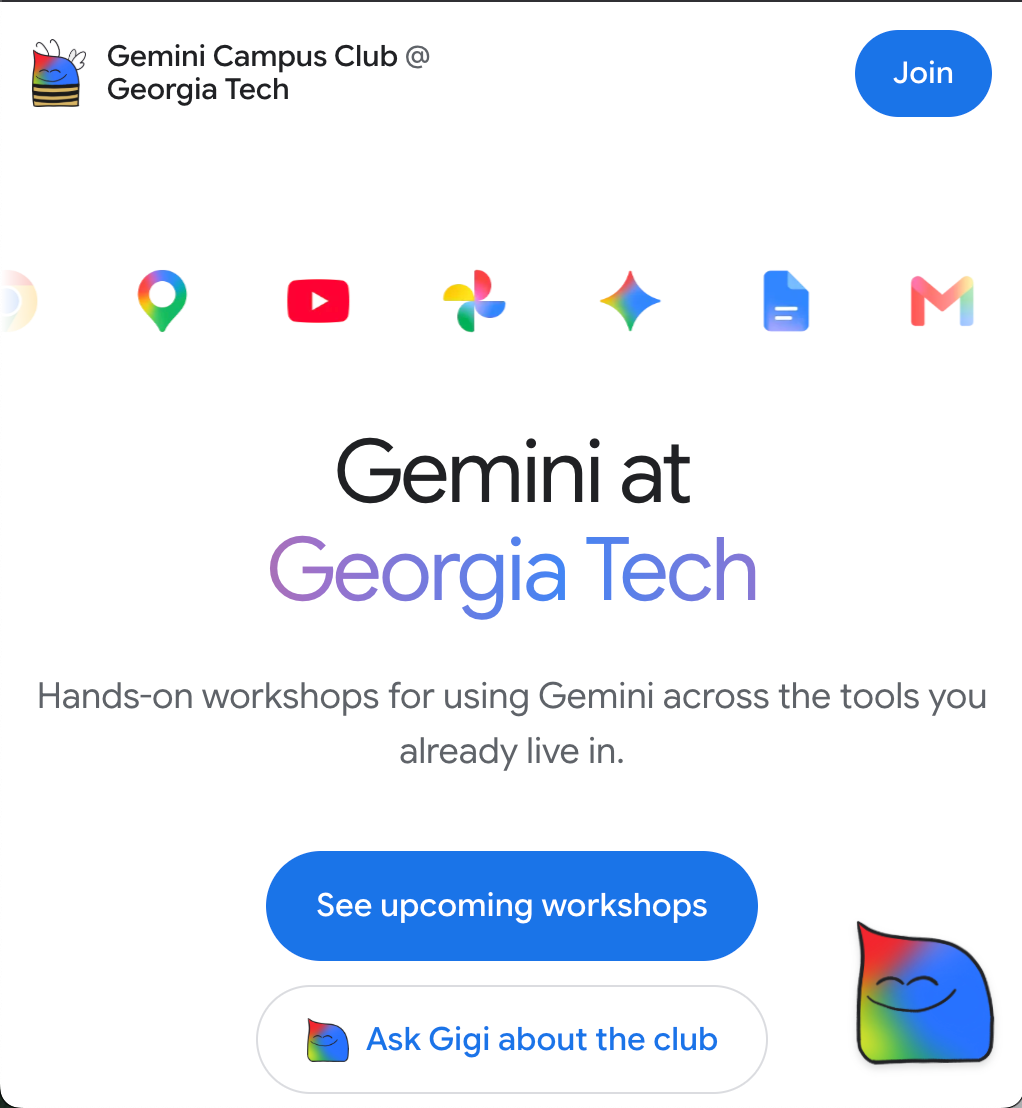
Now the boring bit, channeling the campus network admin, data protection team, and security function (probably the same person). This is what Google are selling:
Gigi has no technology of its own. It's a mascot, and what it fronts is Google's Gemini student offer. Here's what sits behind it, as of 31 October.
Signing up starts at gemini.google.com/students, on a personal Google account rather than a university one. Enrolment is checked by SheerID, an outside verification company, and a payment method is required. In the US, the plan renews at $19.99 a month once the free year ends, unless the student cancels.
US students get Google AI Pro: Gemini's top model. The bundle also includes Google Health Premium, which connects to Fitbit and other health trackers. Students in more than 140 other countries get the lighter AI Plus. Both get a student hub that turns uploaded lecture notes into study notebooks, flashcards and quizzes.
The reach goes well beyond study. Gemini connects to Google and third-party apps, and its Personal Intelligence feature draws on Gmail, Photos, YouTube and Search history. Google reportedly doesn't train on the inbox or photo library directly. It can train on what you ask about them, and on Gemini's answers.
That training is on by default. On a personal account, chats are used to improve Google's services, including training its AI models, and some are read by human reviewers, including outside contractors. Reviewed chats are kept for up to three years and survive deleting your history. Chats are kept for 18 months by default, and even with the setting switched off, Google holds them for 72 hours. A paid plan doesn't change the rules, and other Google settings keep collecting regardless.
Universities sign up to something different. Google's Workspace terms, the version institutions buy, say customer data isn't used for training without permission and isn't read by human reviewers. So the student offer quietly moves study activity from the university account, where training is off, to a personal one, where it's on. Students can switch it off, but only if they know to look and take the trouble.
The AI data and image problem
Gigi and its broader campus campaign wasn't aimed at the UK and Europe, likely why it didn't hit my radar until I dug into this cute as consent research. That fits a pattern. The stricter data protection laws and consumer attitudes to privacy make it a far riskier student data connection and collection venture.
Europe and the UK get a narrower Gemini. Google withholds the features that combine data across services rather than seek consent for them, though basic chat training still runs under weaker protection than consent.
What’s withheld
- Personal Intelligence, which lets Gemini draw on Gmail, Calendar, Drive, Photos, YouTube, Maps and Search, is not available in the EEA, Switzerland, the UK or Nigeria, per Google’s own help page.
- Agent tasks depend on it: they need a personal adult account, AI Pro or Ultra, and Keep Activity on. Gemini Spark is unavailable in the UK and EU with no published timeline.
- The pattern continues. The October Android Auto rollout of Personal Intelligence excludes the same countries.
So a European student’s free AI Plus year is Gemini without the cross-service profiling layer. The full bundle, cute mascot and all, runs in the US.
Then there is a more general problem, one that drives these well-funded pushes into schools to rebrand technology and seed hugely valuable longitudinal data sets that build as young folk explore the internet...
... millions of less enthusiastic young folk
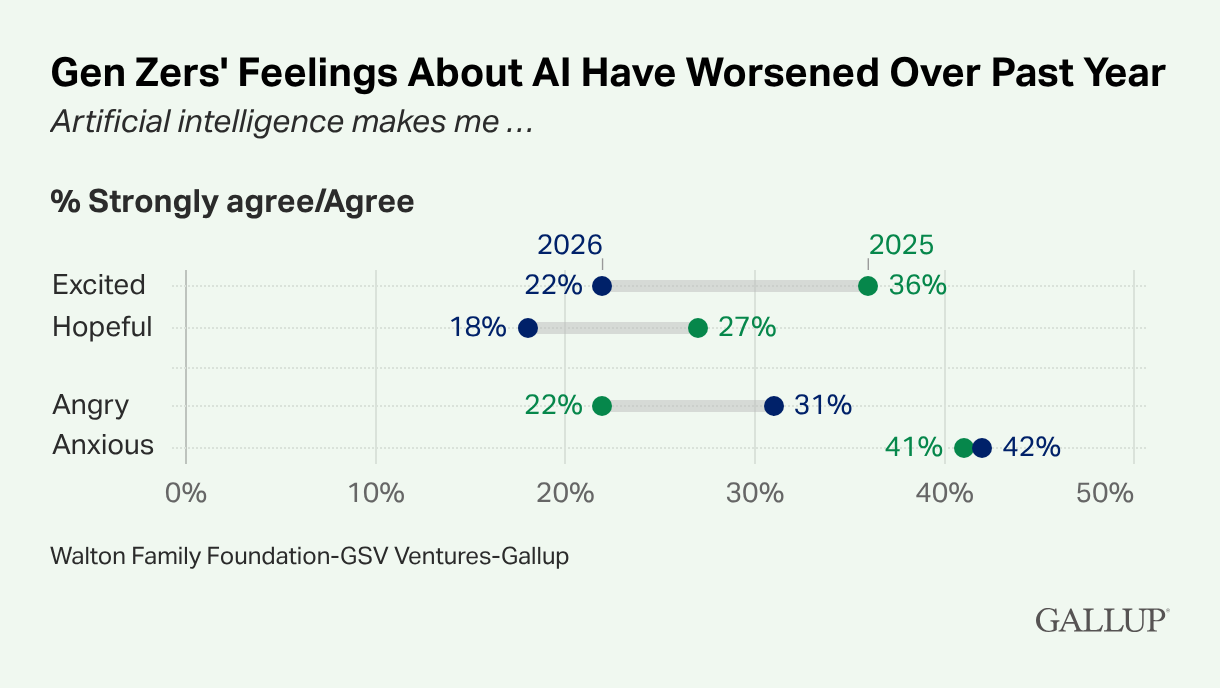
Using something to survive and wanting to use it are different. Young people were supposed to be AI's natural constituency. It hasn't worked out that way.
Gallup's Voices of Gen Z survey, which polled 1,572 Americans aged 14 to 29 this spring, found excitement about AI down 14 points in a year, to 22%. Hopefulness fell to 18%, while anger rose to 31%. Use, meanwhile, is flat: about half use AI weekly, the same as in 2025. Among young workers, those who think AI's risks outweigh its benefits outnumber those who think the opposite by more than three to one. Eight in ten expect it to make learning harder.
Pew's long-running tracker tells the same story over a longer span. In its August release, 55% of under-30s said they were more concerned than excited about AI, up from 31% in 2021. Only 11% now lean the other way. Pew's chart shows the youngest group's concern rising past everyone else's. Five years ago they were the optimists.
The detail that matters most for the cute-mascot strategy is in Gallup's data. Feelings track usage: 59% of non-users feel angry about AI, compared with 18% of daily users. If you're an AI company, the lesson is simple. Get them using it, and the anger softens. The free year, the campus inflatable and the blob with a friendly name all follow from that.
What a pickle they are in, but enough for now. Next time: